

High & Dry
Four of the best wintertime courses in Puget Sound
By Bart Potter • CG Staff Writer
Our golf course superintendents, agronomic superstars though they are, can’t make the rain stop magically at the perimeter of the golf course. Not even the best of them, it seems, can manage the weather.
They know there is one thing, only one, the quality of which truly defines the best golf courses for wintertime play in the Cascade region.
When it’s good, you might not even think about it, even when it’s raining.
When it’s bad, your feet get wet.
That thing, sir or madam golfer, is drainage. In this oft-sodden part of the world, this time of year, you either have it or wish you did.
In this issue, we highlight four golf courses in western Washington that stand out among their peers for superior drainage that lends to the dryness of the golfing ground underfoot, in winter and year-round.
Whether by nature (a “sea of sand” beneath the topsoil) or nurture (lots of hard work), these courses have achieved a level of playability in the winter months that gives hope to cooped-up golfers venturing into the weather.
What makes a good winter course? Golf course professionals interviewed for this story found common ground: the course might be softer in winter, and a player might not get the same bounces and rolls of the ball as in summer, but the golf experience is still good in playing conditions that are not compromised by moisture.
And sometimes, it’s the off-course amenities on a golf property that give comfort on those days that go foul, no matter how suitably geared, garbed and shoed a player might be.
There’s something to be said for drying off around a cold beer in a warm bar.
Capitol City Golf Club
Thurston County
LEARN MORE > Capitol City Golf Club
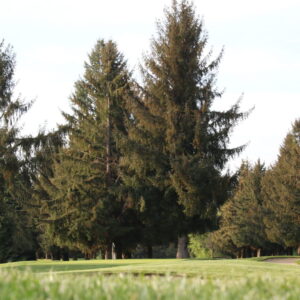
Steve McNelly, general manager at Capitol City Golf Club in Lacey, remembers when he first knew for sure why his course drains as well in the winter as any course in the region.
McNelly thinks it was probably 2008, early in his tenure at Capitol City, when the contractor who dug the trenches for an irrigation project at his course said something revealing.
“He said, ‘Man, if you guys ever want to close this golf course down and sell sand, you’ve got a sea of sand underneath this turf. That’s probably why it drains so well.’”
It made sense to McNelly.
“It really has to do with the ground,” he says.
Superintendent Steve Cox and his Cap City crew do regular aerification and mix in deep tine aerification, for which the longer, solid tines go deeper to penetrate the topsoil so water will go through the ground.
“The soil is very good here,” McNelly said. “I mean, there are no rocks in our soil. It’s just black, beautiful earth, and then apparently there’s just a lot of sand underneath it.”
McNelly said his staff takes pride in the greens and doing what it takes to maintain them through the winter.
“It’s just love and care,” he said. “It obviously has to do with employees knowing what they’re doing. The superintendent, the assistant superintendent, knowing agronomy as well as they do, not sparing any expense to make sure these greens are in great shape.”
Capitol City’s course conditions breed loyalty. McNelly thinks his Winter Tour, which features a tournament every two weeks November through February, might be the biggest in the region.
“It’s amazing. Rain or shine, snow or sleet, 128 people every time. With a waiting list.”
Chambers Bay
Pierce County
LEARN MORE > Chambers Bay
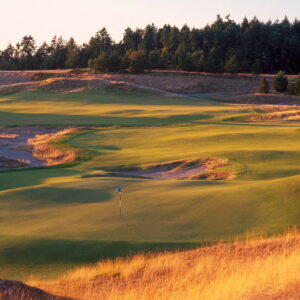
When Chambers Bay Golf Course in University Place was under development in the early 2000s, it was blessed by its location on the sand-rich site of a former gravel mine.
Sandy soil, yes. Ready-made soil for planting golf course grass? No. That took a little work.
Matt Cohen, general manager at Chambers Bay for 18 months, was not around for its raw beginnings. He’s heard the stories.
“One of the things people might not be aware of is they literally had to take every bit of soil and refine it,” he says.
It was a process: Course builders dug up every inch of every fairway, every tee box, every green. Everywhere there is turf today was unearthed, tilled, transported to a sorting and screening area and then filtered to remove abundant rocks and gravel.
Only then was the soil returned to the golf course site to be the base on which turf was actually planted.
“If they had tried to just plant fairways and greens and tees on top of what was existing without disturbing it and screening it as they did, we’d have issues for sure,” Cohen says. “We’d have irrigation issues, we’d have people breaking clubs and wrists, we’d have rocks coming to the surface over time.”
Director of Agronomy Eric Johnson and his grounds staff are helped on the greens by the decision after the 2015 U.S. Open to replace the original fescue greens with poa annua, a cool-season grass.
Today, Chambers Bay has few competitors as a wintertime venue, Cohen says.
“Esthetically, we’re greener this time of year than we are, really, in the summer months. But again, the golf experience is very similar, and you can do it at a very reduced rate.”
Jackson Park
King County
LEARN MORE > JacksonPark Golf Course
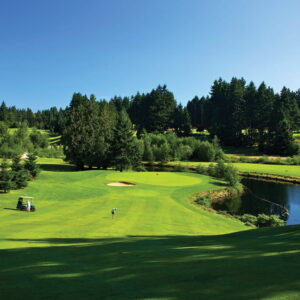
Jackson Park Golf Course in north Seattle takes a whole-facility approach to what constitutes a good day at the golf course on a rainy winter day.
General Manager Matt Lipe touts the expanded and refurbished practice range and the golf simulators that complement it, which offer a covered and heated (on the lower tier) alternative to green-grass golf.
Superintendent Jon Fulmer and crew have worked steadily at overseeding and top-dressing with sand. The results have shown up — Jackson is known as the driest course in the city.
“The fairways and greens are in the best condition they’ve been in since I’ve been here,” Lipe says.
Jackson, a City of Seattle muni managed by Premier Golf, has also addressed an antiquated irrigation system: putting in new lines and heads and getting rid of the old, which helps with moisture management on the course.
“Right now, we’re 100% computer-controlled — fairways, tee boxes and greens on every hole of the course, which has been great,” Lipe says.
All that good work around the course, and there’s winter weather and always will be.
“I mean, it’s still Seattle golf, so no matter how good you think it is, there are still going to be wet spots out there,” Lipe says.
On “those” days, when you just must get out of the weather, you can still go hit balls at Jackson’s two-tier, 50-bay practice range, with a Top Tracer simulator in each bay.
You don’t need good weather to get involved with Jackson Park’s winter Top Tracer leagues that launched in November — the women’s a nine-hole scramble format, the men’s 18-hole individual stroke play.
And Jackson’s restaurant and bar … always welcoming.
“We’ve got a bunch of flat screens in there, and good food and good beer,” Lipe says. “So yeah, it’s nice to get out of the rain.”
Mount Si
King County
LEARN MORE > Mount Si Golf Course
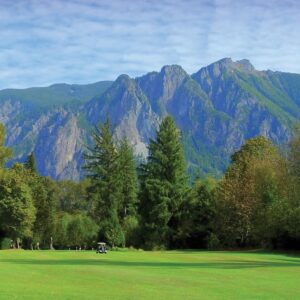
The soil that nurtured the 900-acre Snoqualmie Hop Farm, billed as the largest hop farm in the world in the late 1800s, is the same fertile ground that lay under Mount Si Golf Course when it opened in 1927 in Snoqualmie, Wash., after the market for hops dried up.
In 30-plus years of hanging his rain hat at Mount Si (he started as a cart boy), Scott Barter, now the course’s general manager, has appreciated the silty, sandy soil wrought by the naturalfloodplain of the Snoqualmie River valley.
“We naturally, being in the valley here, just have great soil and drain very well,” Barter said. “I mean, we can get inches of rain, and it really doesn’t even puddle up out here, it just kind of rolls off.”
Superintendent Matt Pilger and crew also benefit from winds in the winter that the course doesn’t get in the summer.
“It can dry it out in a hurry,” Barter said, “because it’s pretty commonplace to have a 10-mile-an-hour wind here in the winter.”
And while the water table is higher being near the river, and floods can happen, the playability of Mount Si isn’t much affected.
“In a high-water event, the river will overcome us where we can be unplayable a couple times a year just because the river flows through,” Barter said. “But it usually recedes within 24 to 48 hours and is kind of back to normal.”
That consistent playability helps Mount Si stay busy in the winter months and fill up tee sheets for the one or two full-field tournaments every winter month.
While the arrival of Prohibition in 1920 put a chill on the hops industry in the Snoqualmie Valley, the sprawling farm left behind a gift in the quick-draining soil that nourishes the grass at Mount Si Golf Course to this day.