Home Turf
From Mud To Masterpiece: The rise of the Northwest turf industry
By Bart Potter • CG Staff Writer
Mike Vandaveer doesn’t believe there’s much excuse for bad, poorly maintained synthetic turf on streetside yards or backyard putting greens — not with the quality of materials today, and the expertise and customer service of companies like Synthetic Turf Northwest (STN) of Woodinville.
From suburban backyards to golf practice greens, STN has spent three decades at the intersection of landscaping, sports engineering and evolving materials science.
Vandaveer, the current owner, says company founder Glenn Charvat was a pioneer in the industry when he launched Advantage Golf Greens, as it was then known, in 1996.
“He quit his career in corporate America and started a synthetic turf company, a long time ago when it was really a huge risk for him and his family,” says Vandaveer.
The company emerged under Charvat during a time when artificial turf was still largely associated with stadium “AstroTurf” surfaces, often criticized for their stiffness and unrealistic look. Early synthetic turf lacked the texture, color variation and durability demanded by residential customers.
Eventually, manufacturers of turf products started to explore what they called “landscape turf” for home installations.
“It was not sports field turf,” says Vandaveer. “It was like, we’re going to try to make these turfs to look and emulate grass.
“For a lot of people in the Northwest, the problem was the space around their home was wet and mucky and muddy more than it was dry,” Vandaveer remembers. “And so Glenn transitioned his business from Advantage Golf Greens to Synthetic Turf Northwest, and he was a premier installer of lawns and putting greens and playground areas, everything that wasn’t a sports field.”
Vandaveer bought the company from Charvat after the two men got paired up by chance at Snohomish Golf Course and ended up talking in the parking lot.
“I saw his car and it had his logos on it. And I said, Hey, I want to get a putting green in my backyard. What does that take? From there, the conversation was, ‘Well, I’m getting ready to turn the lights off on this thing. Do you want to buy the company?’”
Nine months later, in 2015, Vandaveer bought STN and, after some training from Charvat and a little bit of introduction to the industry, he jumped in, just when synthetic turf was about to explode.
And then it did, and the boom is still being felt.
“I was lucky enough to happen upon Glenn and get into synthetic turf when I did,” says Vandaveer. “It’s been fun and interesting to watch and be able to see it explode the way it has.
“Part of what’s important to me now, as it’s booming, is to make sure that it booms responsibly.”
What does “responsibly” mean to Vandaveer in this space?
“Quality products, quality installation,” he says. “There are neighborhoods you can go into now where it’s just a hodgepodge mess of DIY front yards and just weird material purchased cheaply through big box stores where, you know, people’s version of quality is very different.”
Over time, STN built its business around installing hundreds of synthetic lawns and golf practice greens in western Washington, from Bellingham to Olympia, for both residential and commercial clients.
“In 2015, I would sell you turf and tell you, well, I can have the turf in three weeks,” Vandaveer says. “And I would see you in three weeks.”
In recent years, STN has expanded its operations to include a second warehouse in Fife, reflecting a shift toward vertically integrated service combining supply, fabrication and installation under one umbrella.
“Now we have a warehouse full of products that we’ve manufactured or designed,” Vandaveer says. “And in our warehouses, we actually cut the turf based on the cuts that you need, and we put it on your truck right in the warehouse.”
The company’s growth reflects broader shifts in landscaping preferences — particularly in the Pacific Northwest, where heavy rainfall, shade and maintenance costs can make natural grass challenging.
STN has emphasized craftsmanship and local expertise.
“You call me directly and I install your turf, which is the biggest part of my business,” Vandaveer says. “The next part of my business is you come to my warehouse and you buy from me at retail or as a contractor.
“And then one of our third lines of revenue is the care business, where we’re aggressively getting out to people and helping them maintain their turf so it doesn’t turn into an eyesore.”
In addition to STN, other leading synthetic turf companies were showcased at the Seattle Golf Show in March including: Sta-Built Construction, Thurston Turf & Pavers, GrassLand Synthetic Turf and System Pavers. Clearly the industry is strong and growing.
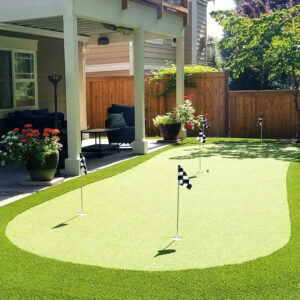
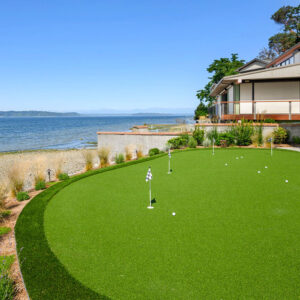
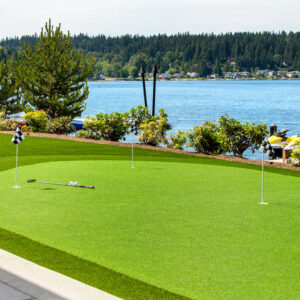
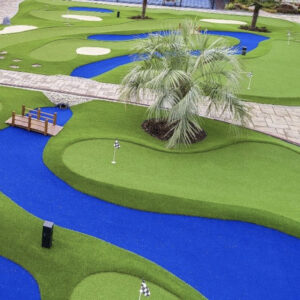
Modern synthetic putting surfaces deliver consistent ball roll, customizable speed and contouring that mimics real course conditions. Installations can include fringe areas, sand bunkers and multi-hole layouts, allowing users to practice a range of short-game techniques without leaving home.
Unlike AstroTurf and other early formulations, today’s surfaces feature multi-tone fibers, varied blade shapes and lengths, and improved underlayment for drainage — critical in western Washington’s wet climate — while keeping the playing surface stable.
When Vandaveer’s team is crafting a putting green for a home customer, he says, he takes an artist’s approach.
“We always try to give people a left to right, a right to left, and a straight flat. We try to let the homeowner be a part of the design process. And it’s fun for them, and they can put their own fingerprint on the golf green.”
It might not be a simple process to have a quality golf green installed in your back yard. But it is easy, if you hire the right people to get it right.