

River Ranch Revealed
David McLay Kidd’s Snake River project takes shape
By Tony Dear • CG Editor
In the December issue, we reported that David McLay Kidd was building a new course on cliffs overlooking the Snake River, about 15 miles northeast of Pasco. We didn’t state the course’s name for a very good reason — it didn’t have one yet. That changed on January 21 at the PGA Merchandise Show in Orlando. Kidd, along with KemperSports which will manage the course, filled in a lot of the gaps involving the project’s plans and business model, and announced what it will be called — River Ranch.

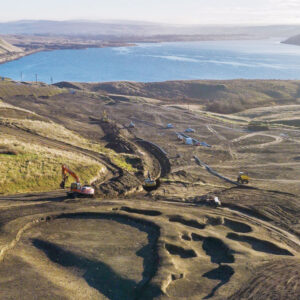
Readers will probably have seen pictures of the amazing site which, until about six years ago, was owned by the Gordon Estate Winery and the Gordon Family’s own vineyard operation, Kamiak Vineyards Inc. Winemaker Jeff Gordon had purchased 200 acres in 1978, planted his first vineyard in 1980, and produced his first wine in 1985. But the business began to fail in the mid-2010s and, following initiation of bankruptcy hearings, the winery scaled down operations, and the property was sold in August 2024.
The bankruptcy case finally closed in July 2025, but it took until the end of the year for the winery to wind down, sell its assets and fully vacate the premises. By then, of course, the land had been stripped of its vines and cherry trees, and work had begun on the golf course that the new owners sought to create.
The ownership group comprises four local businessmen — developers Ben Harris and Kennewick Council member Brad Beauchamp, who formed North 44 Homes in 2018, together with Keith Tiegs and his son, Jordan. Keith is son of the late agricultural titan Frank Tiegs, whose 30-plus businesses still employ over 5,000 people, own 20 food-processing plants, and farm over 140,000 acres across the Northwest.
The four joined forces to bid on more than 300 acres of the Gordon Estate that had become available and, according to tricitiesbusinessnews.com, paid $9.2 million. Harris and Beauchamp had grown up fishing and boating at the now closed, and sadly neglected, Levey Park, which juts into the river east of where the golf course will be. They initially wanted to repurpose the park as a marina with adjoining cabins. But, after walking the land with their new business partners, the idea of a golf course came up, and the thought of using this incredible place for potatoes, onions, fruit trees (or worse, houses) quickly faded.
And who better to design and build a world-class golf course in the Pacific Northwest than David McLay Kidd, the Scot who now lives in Bend, Ore., and who has created a handful of the region’s very best courses.
As we noted in December, just a few weeks after the land purchase was confirmed, Harris called Kidd, who warned him that he turned down far more proposals than he accepted. Harris insisted Kidd come and see the site for himself, and about six months later, Kidd’s diary finally allowed him a window of opportunity.
As we now know, Harris hadn’t been joking about the quality of his property. Kidd called it a “unicorn” and said it had everything a golf course architect hoped for — sandy soils, awesome views, interesting topography, and a year-round golf climate. The fact it was so close to his adopted home, and there was no immediate need for a housing component just made it all the better.
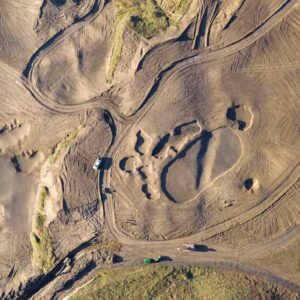
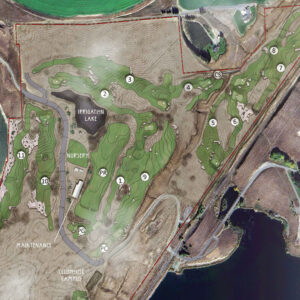
Construction began initially on five holes last November with Kidd working alongside Caden Jensen, an assistant construction manager with Kidd’s own course construction company, Golf Landscapes. Jensen worked under Kidd’s design partner, Nick Schaan, on Scarecrow at Gamble Sands.
Shaping continued in the new year and should be complete by late spring when the course will be grassed. It’s not clear yet when it will open but the target is August 2027. Right now, it’s thought the course will be entirely fescue, although bent grass may be used for the greens. And though there will be membership categories with members enjoying early access to the brand-new course, the development will actually be a high-end destination resort open to the public with guest cottages and upscale dining.
Kidd hopes River Ranch will become a significant part of a long-haul trip international golfers make that might also include visits to Chambers Bay, Bandon Dunes, Gamble Sands, Scarecrow, and Wine Valley.
And while Keith Tiegs likewise hopes it will put southeast Washington on the world golf map, he is also aware of how beneficial it could be to the local market.
“By drawing visiting golfers and receiving widespread attention, it will strengthen the entire golf ecosystem,” he says. “It will benefit public courses, private clubs, hospitality providers, and tourism partners alike. Ultimately, this project is not just a new course, but rather an anchor asset that will raise visibility and credibility and have a significant economic impact across the region for years to come.”
Horn Rapid’s Garza heralds his home
A ‘rising tide’ for the Tri-Cities
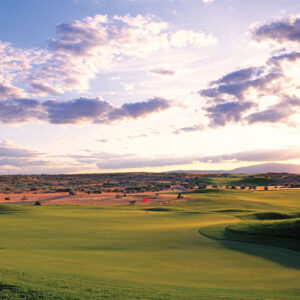
Tri-Cities golf insider and Head Professional of the Keith Foster-designed Horn Rapids Golf Course Josh Garza is excited about the development of River Ranch and supports it all the way.
“It’s such an awesome place and, as Bandon Dunes and Gamble Sands would indicate, a course designed by David McLay Kidd is going to be enjoyable from start to finish,” Garza says. “Golfers and golf businesses here should be embracing it with open arms.”
Garza hopes Washingtonians and Oregonians who travel to the Tri-Cities to play the new course and stay for a few days also visit the Cities’ other layouts. There’s Horn Rapids, of course, as well as the very highly thought of Canyon Lakes, which opened in 1981 and was designed by John Steidel. There’s also Jim Engh’s excellent Columbia Point and the lovely Sun Willows designed by Robert Muir Graves and opened in 1960. And then there’s the short but always enjoyable Zintel Creek, which opened in 1938 as the Twin City Country Club, became the Tri-City Country Club in 1948 and, in 2017, was purchased by 20 members who wanted to save it from the threat of being bulldozed. (If they’re fortunate enough to know someone, golfers might also get a game at the private Meadow Springs.)
“I hope River Ranch will create a rising tide that floats all boats,” Garza adds.
Before a shot is struck at River Ranch, though, Horn Rapids will continue to enhance the visitor experience.
“We want to continue making upgrades and positive changes to the golf course every year,” says Garza. “Our goal will always be to make noticeable changes that golfers want to see.”
An important recent improvement has been adding more sand to the bunkers.
“Now they play better, look better, and are easier to get out of,” says Garza. “We want them to be hazards, but we also want to give people a better chance of getting out of them, which was becoming harder to do as we lost sand.”
The course will also continue to monitor the height of bunker lips. It doesn’t want bunker shots to be easy and not cause players at least a little anxiety, but it’s not hosting the U.S. Open.
“The bunkers should be a challenge without golfers being stuck in them for long,” says Garza.
A new tee box has been added to the 497-yard 18th hole with the aim of encouraging golfers to take on the left side of the hole, threading the needle between the bunkers on the left side of the fairway and the practice range. Take that line and you’ll likely be hitting your second from a fairly bare desert lie, but it should be very playable and the distance you have remaining to the green will be cut significantly. It gives an extra ripple of interest to an already interesting hole.
The fairways should have been aerated by the time you read this (phone ahead to make sure), which will make them play beautifully come the start of the summer season. It can certainly get pretty warm in the Tri-Cities during July and August but, from late April through June, the needle hovers around the high 60s to the high 70s, which most Pacific Northwesterners will probably prefer. And the sun will more than likely come out — the Tri-Cities receive about one-fifth as much rainfall as Seattle does in a year, and there are twice as many days when the sun shines.
With better bunkers, aerated fairways, an altered closing hole, much-improved irrigation over the last few years under Brad Rew’s management, and the always great weather, Horn Rapids promises to be a popular stop for Washington golfers this year.
River Ranch will likely be the Tri-Cities’ ultimate showstopper in future years, but Horn Rapids is definitely making strides to be the next best game in town.