

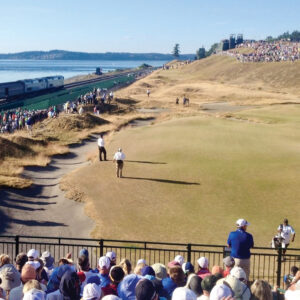
10 years after the Open
The world watched, crowds came, millions of dollars were generated — will it happen again?
By Bob Sherwin • CG Staff Writer
It was the players who made the most noise — heard and repeated even 10 years after the 2015 U.S. Open Championship at Chambers Bay. Those who remember the Open well, still can hear the cheers, comments and critical statements — those of acclaim and chiding – like it was yesterday.
But all the commotion shouldn’t have risen to the level it did. Without exception, players complain about the course setup, particularly the greens, at every major. Winners never do.
The criticism slightly tarnished what should have been a lasting regional celebration of those four days in mid-June 2015 — a record in ticket sales, sold out 11 months before the event, a then-record in merchandise sales and corporate tents, an outpouring of volunteers, more than 80 million TV viewers around the globe, and more than $134 million generated from the event into the local economy.
“No single event in the history of the state has ever generated that type of revenue,” Pierce County Executive Pat McCarty said after the final putt.
The overall highlight, diminished by the green noise, was a stacked leaderboard — the game’s greatest players among the top five — with a clutch play down the stretch Sunday and a dramatic finish on 18, won by young Jordan Spieth when Dustin Johnson three-putted from 12 feet to lose by one stroke.
Ten years after, it’s time to take a second look, a mulligan of sorts, to remember the bits and pieces that came together for 115th edition of the U.S. Open at Chambers Bay.
‘We don’t need another golf course in Pierce County’
Twenty-five years ago, Pierce County Executive John Ladenburg had a dilemma — what to do with this abandoned gravel pit in University Place. It cost the county $33 million and needed millions more, public or private, to develop anything out of it. Plenty big enough, some suggested, to create two full 18-hole golf courses on the site.
Pierce County already had enough courses, Ladenburg believed. Lake Spanaway, Allenmore, Meadow Park, among others.
“I came to the conclusion, we don’t need another golf course,” said Ladenburg, shutting it down soon after he took office in 2000.
Golf courses don’t generate the kind of revenue needed to make the site viable. However, he would soon realize that hosting one of golf’s major tournaments certainly would. Imagine, this unruly and nothing stretch of dirty gravel becoming a world-renown golf course? How? Attracting the world’s best players? Why?
Ladenburg researched the PGA Tour’s Phoenix Open (Waste Management) and couldn’t believe how much revenue the city generated. At the time, he was also president of the regional Puget Sound Economic Development Council and proposed a plan, linked to a U.S. Open vision, that this could pay off in grand fashion for the city, the county and the region.
“It made sense, a course that can generate revenue, serve the community and bring in people from around the world,” said Jay Blasi, who worked for Jones at time and is the man who shaped Chambers’ terrain. “We openly discussed (the U.S. Open) from the beginning.”
The Chambers team also took a page out of the 2002 U.S. Open at Bethpage Black, the first time the event was contested on a true public course, breaking a 107-year-old USGA tradition. Bethpage went through a remodel before the Open and the USGA, which hosts 15 national championships each year including the crown jewel U.S. Open, provided the needed parameters.
From the first shovel turn, Chambers also involved then-USGA Executive Director Mike Davis. He visited several times, offering guidance to what the USGA would need, inside and outside the ropes, to hold a major there. Chambers Bay opened in the summer of 2007. Eight months later, Feb. 8, 2008, the USGA awarded the course its 2010 U.S. Amateur and the 2015 U.S. Open.
Leaderboard: Top 10 names of acclaim and fame that week
There were winners as well as losers at the 115th Open. Here are a handful of folks who made a name for themselves for what they did, or what they said:
• Jordan Spieth
Spieth became the youngest U.S. Open champion since Bobby Jones in 1923. He finished at 5 under par, one stroke ahead of runner-up Dustin Johnson, who three-putted 18 from 12 feet, and Louis Oosthuizen. Spieth made a 25-foot birdie on 16 but doubled 17, dropping into a tie with Oosthuizen at 4-under. There’s a plaque embedded on the par-5 18th fairway that honors Spieth’s 3-wood approach to the final green, 18 feet from the hole. His birdie would hold up as the winner.
• Henrik Stenson
Stenson had the imaginative quote of the tournament when he said that Chambers Bay greens’ surface “was pretty much like putting on broccoli.”
• Justin Rose
Tried to maintain a lighter tone, saying he had a five-foot putt “and didn’t have the first idea what it was going to do. It felt like outdoor bingo at that point.”
• Gary Player
Much more knee jerk in his quick appraisal and, in return, was viewed as bitter by some. He said Chambers was “the worst golf course I might’ve ever seen in the 63 years as a professional golfer … it’s basically unplayable.” Perhaps Player had a grudge against Chambers — and Trent Jones, Jr. Player’s design team bid didn’t make the final five.
• Louis Oosthuizen
Chambers was too difficult, unplayable? Oosthuizen recorded six birdies over his final seven holes Sunday for a 9-under 29, a U.S. Open back-nine record. Point to Louis.
• Michael Greller
Jordan Spieth’s caddie (also on the bag for Spieth’s victory at The Masters two months earlier), Greller was a teacher at a Tacoma middle school, occasionally caddying at Chambers. Justin Thomas used him for an amateur tournament years earlier and suggested that Spieth try him. Greller, who lived in Gig Harbor, was given full credit by Spieth afterward for his local knowledge. The two have been together for a decade now.
• Mike Davis
The longtime former USGA executive director was involved almost from the beginning with the Chambers Bay designers. He guided them for what the USGA needed to host an Open. He was also instrumental in the course setup. Davis and a team of USGA and Chambers Bay leaders formed and executed the plans that led to the storied history on both sides of the ropes in 2015.
• John Landenburg
The Pierce County executive in the early 2000s when decisions needed to be made on what to do with the Chambers Creek degraded gravel pit. He guided the county through the design process, bringing the USGA along as well. His vision and support for a world-class golf course and $134.5 million generated from the Open are his legacy.
• Mother Nature
It wasn’t Her fault. It never is. But the weather was quite abnormal that June 2015 week. Two weeks before and two weeks after, the weather was perfect, the grass was perfect. But that unseasonably hot, dry Open week put humans in an untenable quandary. Such is life.
• Greg Norman
The booth analyst for FOX appeared unenthused. Could it have been related to his early 90s partnership with FOX for the World Golf Tour? That never got off the ground because of being contentious with the PGA Tour. Norman lasted just one year at FOX, which also had signed a 12-year, $1.1 billion deal and backed out after just five years. This summer, the network began broadcasting the Norman-promoted, Saudi-backed LIV Golf tour with ratings that are far below that of the PGA Tour.
… every critical decision that needed to be made, one question was always asked: “Does this get us a step closer to the U.S. Open or not?”
A fancy clubhouse or an epic hole?
When the price tag for the course’s buildup pushed past $30 million, it sparked criticism among county leadership and citizenry. Detractors called it Ladenburg’s Folly. But the Pierce County exec said for every critical decision that needed to be made, one question was always asked: “Does this get us a step closer to the U.S. Open or not?”
A significant crossroads came over a design change for No. 10, a short par 4 directly west of the lower caddie shack/snack shop building. There was an enormous sand hill that the design team said would be much better if a fairway was cut through the middle. It meant a half million cubic yards of sand needed to be moved at a significant hit to the budget. The county council denied the extra expense, but Ladenburg didn’t want the course to be compromised. So, he moved money over by cutting the clubhouse budget.
No. 10, now with two giant sand dunes guarding each side, has been praised for its design quality.
Will we get another? Someday maybe — we just hope to be alive
How many more U.S. Opens would Chambers get? At one point, a lot, everyone thought? Turns out thus far, this was just one brief shining moment.
There’s not another one in the queue, even after Chambers completed its major renovation in 2019, replacing its highly criticized fescue greens with more reliable poa annua. In 2020, the USGA changed its scheduling policy, deciding to go with “anchor sites,” traditional courses that have held the event multiple times.
“Anchor” courses such as Pebble Beach, Oakmont, Shinnecock, Pinehurst No. 2, Merion, Oakland Hills, Winged Foot and L.A. Country Club have taken up almost all available spaces through 2051. We are a quarter into the 21st century with nearly a half century of U.S. Open commitments.
The first Open opportunity will be 2043 and then again in 2045, 2046 and 2048.
So, let’s say Chambers finally is granted the Open in 2045 — 30 years, or one full generation of golfers and fans in between. According to the PGA Tour’s marketing research, the average age of patrons attending Tour events is 57. That means all those 57-year-old folks who were here in 2015 and are hoping to see another U.S. Open at Chambers Bay will need to survive to 87. Spieth, the youngest to win the Open (21) since 1923, would be 52 and the likely winner would still be a few years away from being born.
If Chambers should secure a second Open a couple decades away, the folks who were part of the negotiating process for 2015 likely won’t be around to witness it.
Openings are sooner for the PGA Championship, as early as 2032 and 2033.
“I’m lobbying for a U.S. Women’s Open,” Ladenburg said. “I’d like to see that first.”
He argues that the LPGA Tour has many stars from Japan, Korea, Taiwan, “and the Pacific Northwest is the closest connection to Asia. I guarantee that if they bring a Women’s Open here, you’d have 10,000 tourists come here from Asia.”
However, the next Women’s vacancy is 2039, as some of the same “anchor sites” will be hosting it more than once: Pebble, Oakmont, L.A. Country Club, Merion and Shinnecock.
Blasi, who now runs Jay Blasi Design, agreed that a women’s major would work well for Chambers and added, “it’s a perfect match play course for a Ryder Cup or Presidents Cup.”
There have been thoughts about whether a LIV event would be a good idea, bringing back Norman, FOX TV coverage and exhibition team golf.
Discuss amongst yourselves…
Epilogue
For us at Cascade Golfer, we’ve been with and a part of the story at Chambers Bay since the first shovel went into the ground — arguably as much as any one news entity anywhere. Our staff has covered every major development since then and it’s our contention that it truly is a bucket list course. Robert Trent Jones Jr., Jay Blasi, John Landenburg, the superintendents, County, USGA and hundreds of men and women that have played into the never-ending crafting of the place have seen their dream fully realized — especially now.
From our point of view, this space and place deserves another major — we shall keep hope alive.